Radical Homes and Queering Masculinities: Listening to Stasis in Andrew Kung’s Dreaming on the Hudson
*This essay was a submitted assignment in fulfilment of my Master’s at SOAS.
“To me it is crucial to think about futurity through a notion of “tense”. [...] “it is a tense of anteriority, a tense relationship to an idea of possibility that is neither innocent nor naive. Nor is it necessarily heroic or intentional. It is often humble and strategic, subtle and discriminating. It is devious and exacting. It’s not always loud and demanding. It is frequently quiet and opportunistic, dogged and disruptive.” (Campt 2017, 17)
Resting across the landscape of the Hudson River Valley, the subjects of Andrew Kung’s photo series, Dreaming on the Hudson, are Asian men. Striking against the expansive American landscape, their subjecthood presents an interaction with the land that subverts historical tenses of ownership and claim. The American land, historically a symbol of adventure and conquest for American settlers, also symbolises home for indigenous and diaspora communities – then and now.
Tina Campt, in Listening to Images, examines the absence of memory in photographs as “visual archive(s) of desire” (2017, 21). She examines the stasis of passport photographs, noting their quietness, yet how they “ruminate loudly on practices of diasporic refusal, fugitivity, and futurity” (2017, 24). In the context of black subjecthood, she argues ‘quiet’ or ‘stasis’ does not conflate ‘silence’, but is instead a site of survival and refusal (2017, 6). Extending Campt’s inquiry to the Asian-American diaspora, the absence of memory has unique connotations. Historically perceived as adaptable, quiet, and compliant, Asian-American men are also consistently de-masculinised and de-sexualised. Their ‘quiet’ is not only conflated with silence, but with weakness. Kung draws on the affects of quiet Asian-American masculinity, inviting us to listen to the low hum of these images. Here, Asian men emerge as authoritative, unapologetic, and striking subjects in their stasis. For Kung, quiet is synonymous with peace. Further, Gayatri Gopinath, in Impossible Desires, rejects diaspora as anti-nationalist; arguing “if within heteronormative logic the queer is seen as the debased and inadequate copy of the heterosexual, so too is diaspora within nationalist logic positioned as the queer Other of the nation, its inauthentic imitation” (2005, 11). The framework of a queer diaspora thus emerges, “radically situat(ing) questions of home, dwelling and the domestic space” (2005, 14). Through this framework, Kung’s placement of Asian men on the American pastoral reimagines masculine bodily interaction with land. These diasporic subjects stand authoritative, but do not invoke notions of conquest and ownership typically associated with it. They instead invoke a radical way of living with and not on the pastoral.
Central to diaspora analysis is the power relations that exist within them (Gopinath 2005, 2). The history of East Asians in the U.S. has largely been invisibilized, breathing new analytical potential to the absence of memory signifying this diaspora. The Chinese arrived in the U.S. in the mid-nineteenth century, largely working in gold mines and railroads; Congress passed the Chinese Exclusion Act in 1882, following local uproar about decreasing work opportunities due to Chinese presence (Asia Society 2019). Japanese immigration was restricted in 1907, and by 1924, Asian immigrants were denied citizenship, land and could not marry outside of their race (Asia Society 2019). Just as the land is an archive for American history, the masculine Asian-American body is an archive of desire, stemming from a history of erasure, invisibilization and exclusion. This essay will utilise Gopinath’s queer diasporic framework to “listen” to Dreaming on the Hudson, examining Kung’s radical imaginings of home and queer masculinity. It will do so by analysing the ‘quiet’ tenses of diasporic memory and futurity magnified in Dreaming on the Hudson.
Home: contesting histories, queering the land
Dreaming on the Hudson found its inspiration from the Hudson River School art movement of the nineteenth century (Kung 2022). Paintings of the movement depict the expansive natural landscapes of America, invoking patriotic glory and claim for its American spectators/settlers. The American pastoral is thus seminal to white American masculinity, symbolic of land ownership, commodification and conquest. However, Kung invites us to listen to the “hum of utopian dreams and diasporic aspiration” (Campt 2017, 45) that resonates in the stillness of his subjects. The quiet yet prominent presence of Kung’s subjects disrupt desire for this landscape, queering notions of white masculinity and dominance. Reflecting on the Hudson River School movement, it is these “tense modalities of self-fashioning that articulate frictions” between conceptions of the land and the people who are allowed to exist on and within it (Campt 2017, 64). ****Further, as Asian men in the white, American landscape, they are not only queering notions of masculinity, but are representative of “queer diasporic cultural forms” that point to “submerged histories of racist and coloniality violence that continue to resonate in the present and make themselves felt” (Gopinath 2005, 4). Kung, whether capturing his subjects in moments of interaction or gazing straight into the camera, places these bodies as instead existing with the land rather than on it. Their subjecthood ignites the travelling of histories to the present, imaginatively challenging and reshaping legacies of the diasporic body; what is remembered is “a past time and place riven with contradictions and the violences of multiple uprootings, displacements and exiles” (Gopinath 2005, 4). Through his desire for presence on the land, histories of ‘masculine’ land ownership and commodification are contested through the queer diasporic body.
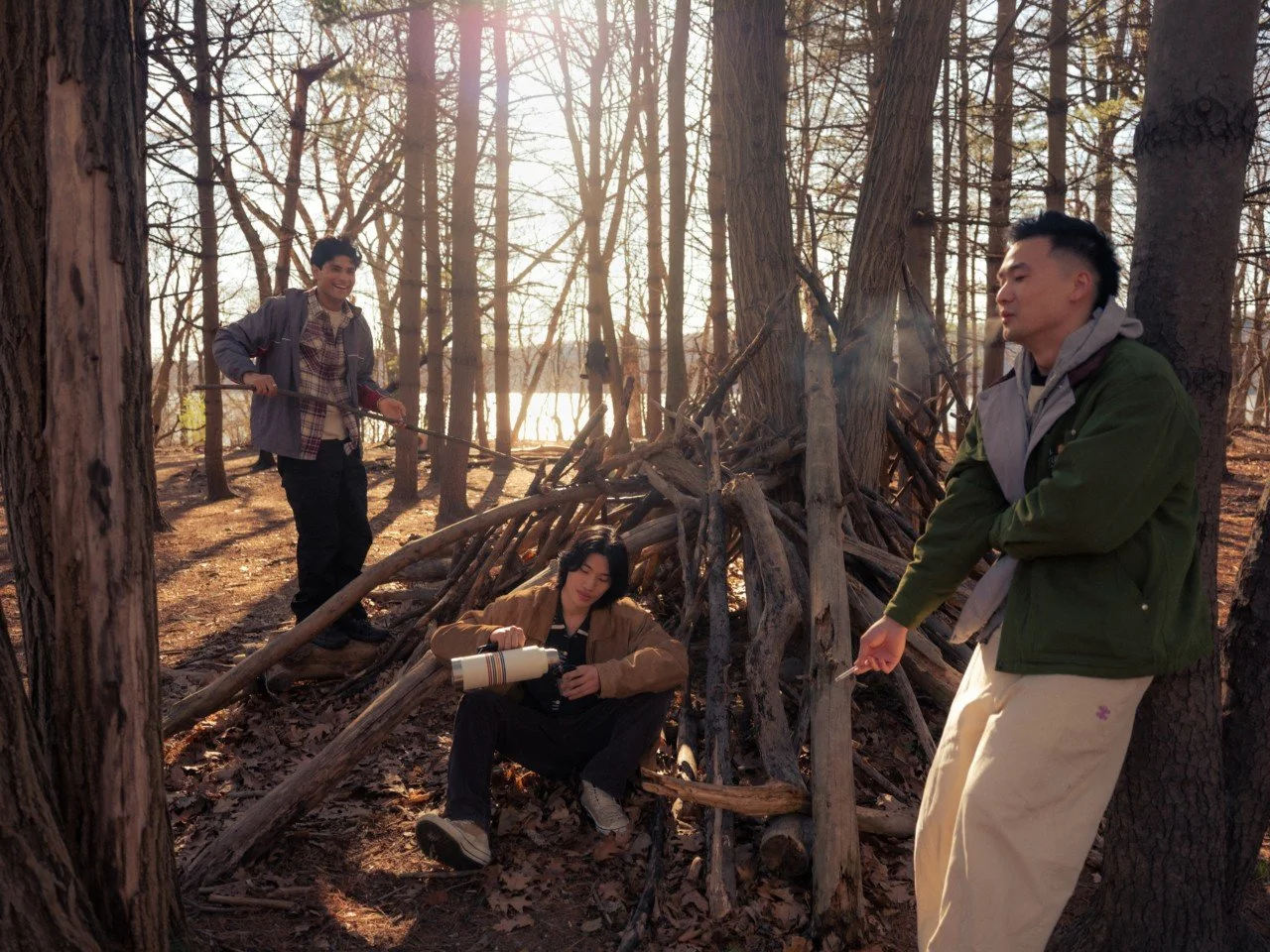
Kung, Andrew. Dreaming on the Hudson (untitled). 2022. Photograph. (Fig. 1)
Anne McClintock further elaborates the American pastoral as nationalist dwelling; she examines the feminisation of the land, which stemmed from a “sense of male anxiety and boundary loss” (1995, 24). This was a “ritualistic moment in imperial discourse”, averting a masculine fear by reinscribing “an excess of gender hierarchy” (McClintock 1995, 24). Against the history of Asian existence on the land, the erasure of their labour is supplemented by this longstanding settler narrative. Furthermore, audiences who would resonate most closely with Kung’s project **are young Asian-American men who are located at the periphery of American nationalism, despite profound roots within the nation. The positioning of subjects in Dreaming on the Hudson queers the interaction between man and land, disrupting conventional narratives and offering a reimagination of home, dwelling, and domesticity. In Fig. 1, three figures are situated around a structure of tree branches. This structure invokes concepts of land inhabitation, but not one that induces fear of male intruders. The composition retains a spatial openness, as one rests to pour water out of his canister, while the background figure playfully tends to the structure, and the foreground figure leans against a tree with a cigarette in his mouth. There is an implied narrative that these men built this together prior to the moment of the photograph; while it is not a form of masculine conquest, it is a manifestation of community and collaboration that creates “home”. Moreover, Gopinath argues the “home” is where evidence of “queer diasporic lives and cultures and the oppositional strategies they enact” is most poignant (2005, 22); Kung embodies this through a seamless blend of subject and landscape; they appear at ease and at home, contrasting the historical persistence of their foreignness. In these images, the land is truly their home.
An archive of bodily desire: Asian-American masculinity at the periphery
Just as the queer diasporic body is an archive of desire, the subject body in Dreaming on the Hudson is an archive of the history of Asian-American masculinity. Gopinath argues, “the queer racialized body” is a historical archive for both individuals and communities (2005, 1). Here, the Asian body is the racialized body, and it is ‘queer’ by its subversive presentation of masculinity. Portrayed in Dreaming on the Hudson is the desire for belonging, excavated through the stasis of the American diaspora (Gopinath 2005, 1). Asian men are typically de-masculinised and de-sexualised within American popular culture; the figure of the Asian-American man is constructed as a meticulous and robotic worker (Tam 2005), incapable of being granted any position of professional authority (Kalita 2023), and thus “terrible for pleasure and self-actualisation” (Tam 2005). As journalist Arthur Tam points out, this has led to Asian-American men “not being well credited for [their] literal contributions to the land” (2005). Similarly, Jana Cattien examines the ‘racialised imaginary of compliance as otherness’ in the context of the Covid-19 pandemic (2022, 4). She argues the image of East Asians wearing face masks was thus perceived as a marker of Asian compliance, enacted by those who come from a place where “authoritarianism rules, not democracy” (Cattien 2022, 4). The enduring construction of Asians as rule-abiding and compliant citizens with no initiative thus excludes Asian men from dominant ideals of masculinity.
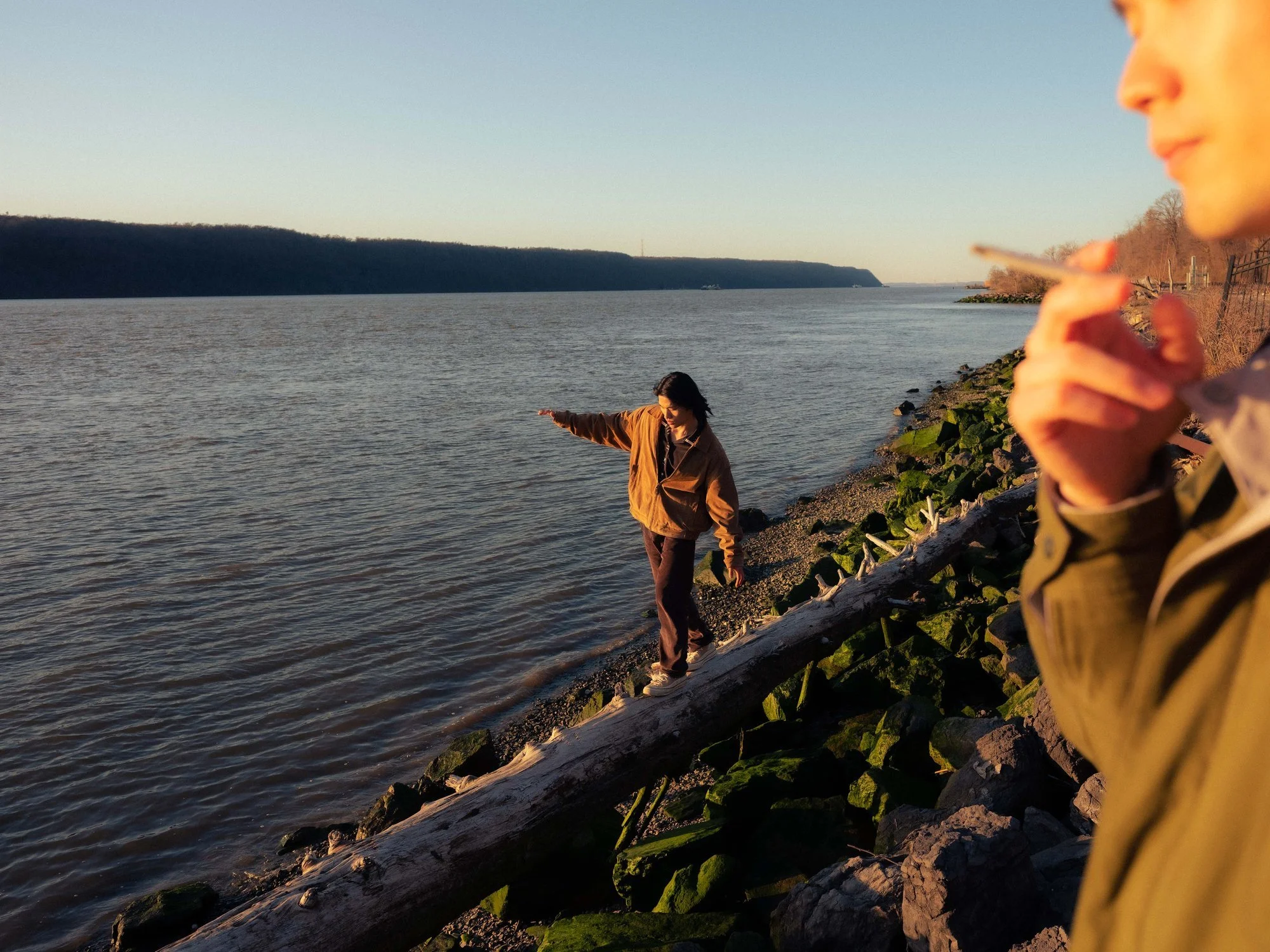
Kung, Andrew. Dreaming on the Hudson (untitled). 2022. Photograph. (Fig. 2)
Fig. 2 is one of Kung’s more candid images; the subject balancing on the log is captured mid-movement, embodying a more vulnerable and precarious masculinity. The foreground subject, on the other hand, is out of frame and out of focus, and can be seen smoking a cigarette. He is, quite literally, situated at the periphery of the American landscape, mirroring the non-presence and invisibilisation of Asian-American men. Situated against the vast and still American landscape, these figures exude a strength nonetheless in the queer masculinity they embody. Through Campt’s methodology, this masculinity and its location is “a performance of a future that hasn’t happened yet but must” (Campt 2017, 17). Further, these subjects represent the queer body which subverts the “various regimes of colonialism, racial and religious absolutism (that) are violently consolidated through the body and its regulations” (Gopinath 2005, 28). This image thus liberates the queer Asian diasporic body from the absence of memory and fractured history, contesting their exclusion not just from heteronormative masculinity but also on American land.
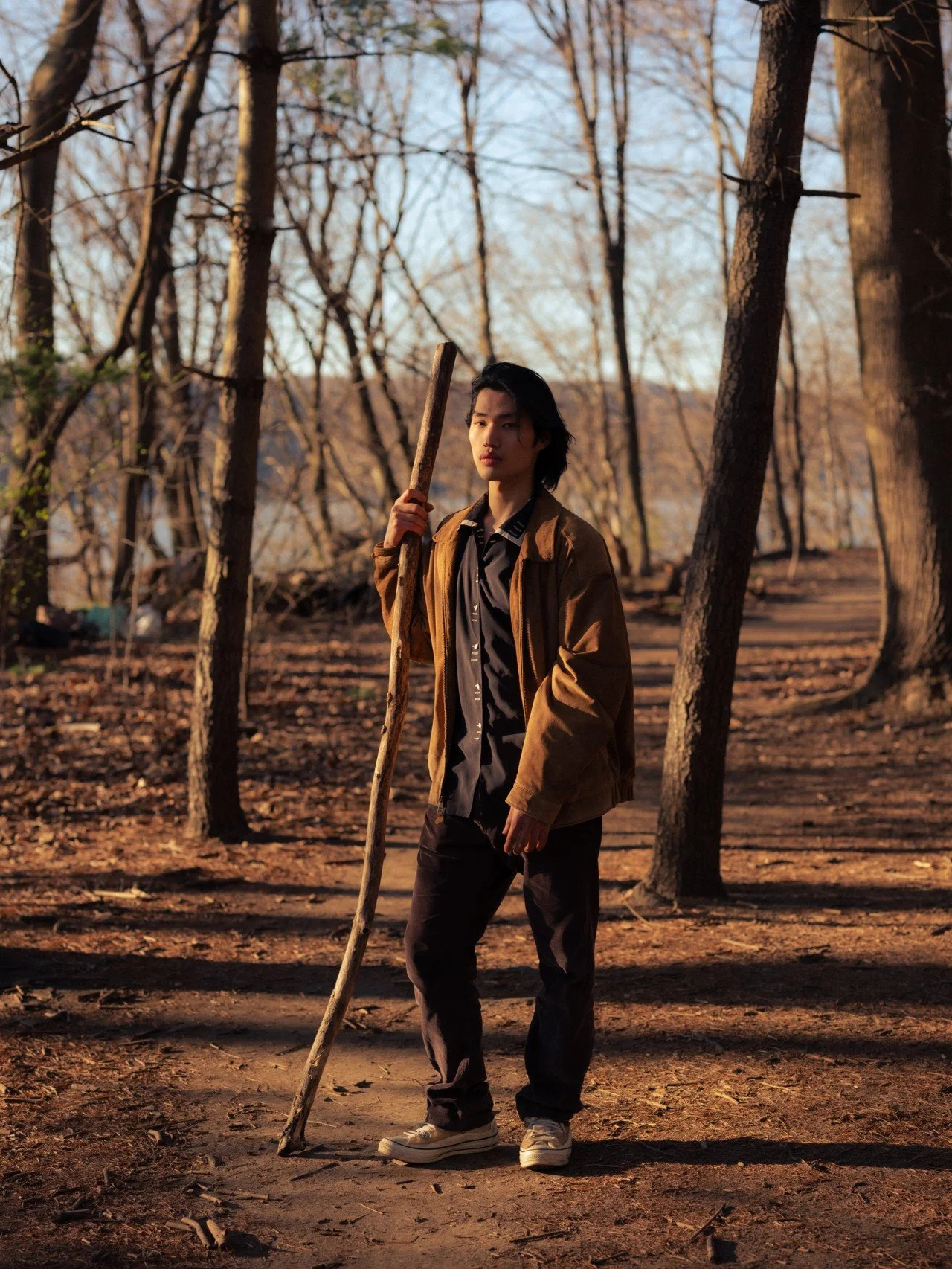
Kung, Andrew. Dreaming on the Hudson (untitled). 2022. Photograph. (Fig. 3)
Campt defines “stasis” as “tensions produced by holding a complex set of forces in suspension” or an “unvisible motion held in tense suspension or temporary equilibrium e.g. vibration” (Campt 2017, 51). In Fig. 3, the subject looks directly into the camera, grasping a stick planted firmly in the ground, reminiscent of American settlers asserting their ownership of the land. The subject, however, exudes a gentle presence; his clothes blend with the landscape around him through colour and state. His expression, far from triumphant, instead reads as peaceful. He is not staking claim to the land but instead existing alongside it. The “tension” that Campt describes is found here in the subject's queering of a familiar pose and setting. The subject’s stasis is central to this image, and what registers is an “effortfully and purposely being, staying, and maintaining [oneself] right here, in this place” (Campt 2017, 65). I read the authority that persists through the subject’s softness as what Gopinath would describe as a “radical disruption of the hierarchies between nation and diaspora, heterosexuality and homosexuality, original and copy, that queer diasporic texts enact” (Gopinath 2005, 13). The image enunciates alternate accounts of memory and stillness that are inherently tied to Asian masculinity and authority. As Tam describes, it is a “deep recognition of Asian male loneliness while expanding on the possibilities of what an Asian American man can be as part of an American cultural landscape” (Tam 2005).
Conclusion
Andrew Kung's photo series Dreaming on the Hudson is a profound exploration of Asian-American masculine identity. The queer diasporic body situated in the vast American landscape challenges traditional narratives of masculinity, ownership, and existence. He instead invites us to read the stasis of the Asian diaspora as a strength; a radical reimagining of notions of home, agency and co-existence. Disrupting diasporic power relations, Kung blends softness with resilience, highlighting the identities of Asian-American men and asserting their presence in nationalist imaginations. As Gopinath states, “when queer subjects register their refusal to abide by the demands placed on bodies to conform to sexual (as well as gendered and racial) norms, they contest the logic and dominance of these regimes” (Gopinath 2005, 28). “Listening” to Dreaming on the Hudson invokes the traditional beauty and wonder of the American pastoral, but instead subverts dominant norms of culture, gender, the self and space.
Notes
Asia Society. 2019. “Asian Americans Then and Now.” Asia Society. 2019. https://asiasociety.org/education/asian-americans-then-and-now.
Campt, Tina. 2017. Listening to Images. Durham ; London: Duke University Press.
Cattien, Jana. 2022. “On Not Becoming Chinese: The Racialisation of Compliance.” Radical Philosophy 2 (12): 3–9. https://www.radicalphilosophy.com/commentary/on-not-becoming-chinese.
Gopinath, Gayatri. 2005. Impossible Desires : Queer Diasporas and South Asian Public Cultures. Durham: Duke University Press.
Kalita, S. Mitra. 2023. “The US Values Asian Work More than Asian Lives.” Time. January 31, 2023. https://time.com/charter/6251395/the-us-values-asian-work-more-than-asian-lives/.
Kung, Andrew. 2024. “Dreaming on the Hudson.” Andrew Kung. 2024. http://www.apkung.com/dreaming-on-the-hudson.
McClintock, Anne. 1995. Imperial Leather: Race, Gender and Sexuality in the Colonial Contest. New York: Routledge.
Tam, Arthur. 2005. “Dreaming of the Hudson: Asian Americans and the All-American Landscape.” Atmos. April 23, 2005. https://atmos.earth/asian-americans-and-the-all-american-landscape/.
